Showing posts with label resources. Show all posts

20100304

016 : Poking Fun at English

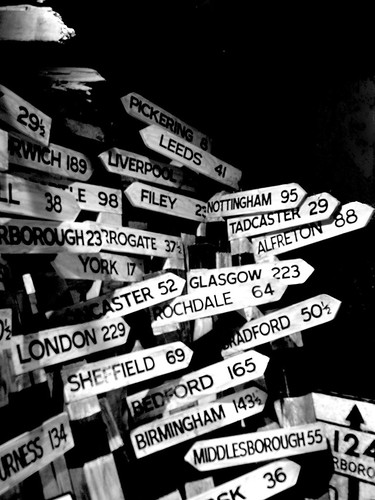
'Confusing the enemy' by werewegian.

Can you pronounce all of the names of places in the above picture? ;)

English is a highly evolving language, as it is affected by other languages into its vocabulary, sound system etc as its number of speakers continue to grow. This is partially also because the cultural divide between English and non-English speakers is getting smaller.

This, of course, is a subject of a lot of debate, as well as plenty of confusion (and hilarity) in the use of the language.

Some time ago, I found an Anonymous poem on why English is so difficult to master for both native and non-native speakers. It really made me laugh out loud.

For your own enjoyment/enlightenment, here it is:

We’ll begin with a box, and the plural is boxes,
But the plural of ox should be oxen, not oxes.
Then one fowl is a goose, but two are called geese,
Yet the plural of mouse should never be meese,
You may find a lone mouse or a whole nest of mice,
But the plural of house is houses, not hice.

If the plural of man is always called men,
Why shouldn’t the plural of pan be called pen?
The cow in the plural may be cows or kine,
But a bow if repeated is never called bine,
And the plural of vow is vows, never vine.

If I speak of a foot and you show me your feet,
And I give you a boot would a pair be called beet?
If one is a tooth, and a whole set are teeth,
Why shouldn’t the plural of booth be called beeth?

If the singular’s this and the plural is these,
Should the plural of kiss ever be nicknamed keese?
Then one may be that and three would be those,
Yet hat in the plural would never be hose,
And the plural of cat is cats, not cose.

We speak of a brother, and also of brethren,
But though we say mother, we never say methren,
Then the masculine pronouns are he, his and him,
But imagine the feminine she, shis and shim,

So the English, I think, you all will agree,
Is the queerest language you ever did see.

There is a similarly amusing poem, but this may be a lot more confusing. And much much longer. It was written in the early 1900s by Gerard Nolst Trenité. Here is an excerpt:

Dearest creature in creation
Studying English pronunciation,
I will teach you in my verse
Sounds like corpse, corps, horse and worse.

I will keep you, Susy, busy,
Make your head with heat grow dizzy;
Tear in eye, your dress you’ll tear;
Queer, fair seer, hear my prayer.
Pray, console your loving poet,
Make my coat look new, dear, sew it!
Just compare heart, hear and heard,
Dies and diet, lord and word.
Sword and sward, retain and Britain
(Mind the latter how it’s written).

Made has not the sound of bade,
Say — said, pay — paid, laid but plaid.
Now I surely will not plague you
With such words as vague and ague,
But be careful how you speak,
Say: gush, bush, steak, streak, break, bleak,
Previous, precious, fuchsia, via,
Recipe, pipe, studding-sail, choir;
Woven, oven, how and low,
Script, receipt, shoe, poem, toe.

Say, expecting fraud and trickery:
Daughter, laughter and Terpsichore,
Branch, ranch, measles, topsails, aisles,
Missiles, similes, reviles.
Wholly, holly, signal, signing,
Same, examining, but mining,
Scholar, vicar, and cigar,
Solar, mica, war and far.
From “desire”: desirable — admirable from “admire”,
Lumber, plumber, bier, but brier,
Topsham, brougham, renown, but known,
Knowledge, done, lone, gone, none, tone,
One, anemone, Balmoral,
Kitchen, lichen, laundry, laurel.

I copied both of these poems from World Wide Words, a site for 'international English'. The poems can be found on this page.

Here's An Idea!

Aside from providing comic relief for the students, you can use these poems as a teaching material eg. lessons on pronunciation, spelling, plurality, learning about homophones/homographs/homonyms, and even on literature (or more specifically poetry)! They might be more suitable for intermediate levels and beyond however, as too many near-words studied together may confuse learners.

Have fun :)

20090726

012 : vouch for visuals!


little boy reaching for a big star, originally uploaded by ajpscs.

Education is sometimes linked to learning either boring/serious facts with few eye-catching attributes in them in the form of worksheets, presentations and handouts. I must admit, adding pictures isn't the main way to get the point across, but it sure does help to gain students' attention and prolong their attention span in a lesson, regardless of what subject you're teaching. Science, languages, social subjects, art (obviously), even maths, there's always the added fun factor when several senses (ie. visual, kinaesthetic and auditory) are used during teaching.

Using images to assist your teaching will also make it more interesting for those who learn through pictures, colors and shapes instead of texts and numbers due to their left/right brain orientation. This is because these 'image-related' activities activates the right side of the brain. Using both sides of the brain helps students to have a better understanding of what they are learning, and at the same time exercises both brain hemispheres instead of focusing on only one.

All that aside, this entry will focus on means to find appropriate AND interesting pictures that I always go to whenever I'm in need of photos. Please not however, that these are user-content sites, so there are copyright issues, so do check where appropriate, and inform/credit where due.

[ link : flickr.com ]

tonnes of amazing photos by amazing photographers, some are personal, some are professional works (no need for signup). The picture in this entry (of the boy reaching up to colorful mobiles) is taken by a flickr user, ajpscs, who takes amazing photos of Japanese culture, among other things.

[ link : sxc.hu ]

Most are royalty-free, high-quality images (requires signup). The top header of the blog, featuring the board and duster, is by a sxc.hu user, ywell. :)

[ link @ jamiekeddie.com ]

He offers 6 links to really interesting sites on the internet.

[ link @catswhocode.com ]

This particular page offers 50 links of free stock image sites of various kind! A few links are no longer working, however.


Of course, you can always Google-imagesearch to find more resources, but remember to use high-resolution images. Resizing images affects the quality of the image, especially so if they are made bigger (making them smaller doesn't reduce the quality as much).


Extra stuff!

When you have images, sometimes it requires a little bit of editing like resizing, sharpenning, blurring etc. To edit images, I use Macromedia Fireworks (or sometimes Adobe Photoshop), but most of the time I only use Irfanview.
[ link : irfanview.com ]

Irfanview is a very simple and compact tool to edit your images. It's extremely lightweight so you can keep it in your computer, laptop, flashdrive, and have it virtually anywhere with you (pun intended ;P). I've used this for years, it's really useful and highly recommended!

Have fun with your visual wanderings on the net and hope this helps!

20090526

011 : cool illustrations for visual aids in the class

Illustrations used in the texts to assist learners are usually pretty dull. Granted, they're usually black & white, so that leaves not much space for them to get our attention to begin with, but they could be spruced up a little, doncha think?

I was looking around the WWW for pictures for my assignment (which involves lesson planning) and I stumbled upon an illustrator by the name of Heather Sloane. She has a few sites under her wings; one of them is Mrs Pancake:
"Mrs Pancake is the teacher everyone loves. She's kind to the kids, always brings treats and just loves making Doodads - wonderful educational resources for parents and teachers."
The site caters to mainly younger children of literacy, numeracy and even for art&crafty subjects, though some things may be useful for the older students as well, like printable certs and some charts.

This site is such an adorable little space worth checking out! :)

[ link : mrspancake.com ]

20090514

009 : funny education-related poetry

If you want to have a 'light' lesson, you may want a 'text' for an activity that can keep the students awake AND interested. A site worth checking is Poetry Teachers. They have a nice assortment of poetry that are quirky, fun and exploitable (in the sense that you can try to create lessons around them, eg. grammar), like this.

It's a cute site worth looking at, even if you don't have teaching intentions in mind :)

20090513

008 : parts of speech, simplified

Need to refresh your mind on what nouns, verbs, adverbs, pronouns, etc are? Or just wanting to find worksheets useful to focus on lessons on these topics? This Enchantedlearning sub-site offers some nice material catering this, and they're also handy because they are explained in a simple way so that if your students are having problems with parts of speech, they can do it in their own time.


007 : more resources for teaching!

Edhelper has puzzlemakers, worksheets, and other convenient stuff for your teaching needs. For the topical worksheets, they are graded according to the level of learners, so it makes it easier for you to suit/adapt the lessons to the needs and abilities of your students.

The site is catered for younger learners and offers stuff for English, Maths and a few other subjects. Their language resources in particular can also be good for ESL learners, regardless of their age.

Note : not all of their resources are free (like most teaching resources), but the ones that are available are worth checking out.


[ link : edhelper.com ]

20090512

006 : adjectives - think you know?

Until a few years ago, I never knew that multiple adjectives (English, at least) had a certain order when combined. This realisation came to me when I was tested for a job interview. I'm not sure how well I did on that test, but I did get the job, and I did learn that there was a proper order for adjectives, so all was good I guess. Haha.

Anyway, for the language teaching course I'm currently studying, we have to do a microteaching session as one of our course requirements. I think adjectives would be a good thing to focus on for this because it's easily underestimated but very much exploitable.

Here's a few links I found particularly useful to know about adjectives and their word orders:


[ link : @enchantedlearning.com ]
[ link : @learn4good.com ]
[ link : @grammar-quizzes.com ]


If you want to try more questions to check your understanding, go here:


[ link : @web2.uvcs.uvic.ca ]
[ link : @johnsesl.com ]
[ link : @edhelper.com ]

005 : some cool teaching resources for younger kids

This site offers (many, albeit limited) free resources for teaching. It has a lot of worksheets on many topics and subjects, so it is suitable for virtually any teacher whose students are in their teens and below.


[ link : abcteach.com ]

002 : learning the interactive way

Here's a blog about teaching languages using, mostly, interactive games. His ideas are mainly technology-based (eg. using the computers, internet, etc), and/but they're very entertaining. They can be used for days when you feel like stepping away from being at the front of the class, and letting the kids have fun (while secretly learning ;) ).