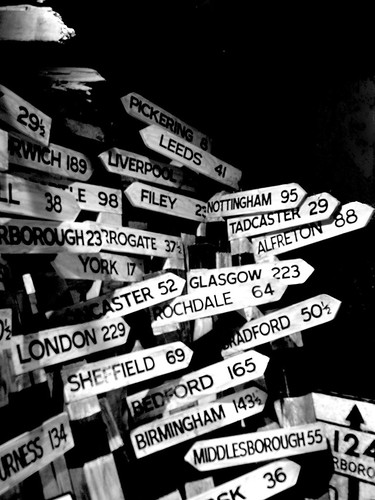
'Confusing the enemy' by werewegian.
Can you pronounce all of the names of places in the above picture? ;)
English is a highly evolving language, as it is affected by other languages into its vocabulary, sound system etc as its number of speakers continue to grow. This is partially also because the cultural divide between English and non-English speakers is getting smaller.
This, of course, is a subject of a lot of debate, as well as plenty of confusion (and hilarity) in the use of the language.
Some time ago, I found an Anonymous poem on why English is so difficult to master for both native and non-native speakers. It really made me laugh out loud.
For your own enjoyment/enlightenment, here it is:
We’ll begin with a box, and the plural is boxes,
But the plural of ox should be oxen, not oxes.
Then one fowl is a goose, but two are called geese,
Yet the plural of mouse should never be meese,
You may find a lone mouse or a whole nest of mice,
But the plural of house is houses, not hice.
If the plural of man is always called men,
Why shouldn’t the plural of pan be called pen?
The cow in the plural may be cows or kine,
But a bow if repeated is never called bine,
And the plural of vow is vows, never vine.
If I speak of a foot and you show me your feet,
And I give you a boot would a pair be called beet?
If one is a tooth, and a whole set are teeth,
Why shouldn’t the plural of booth be called beeth?
If the singular’s this and the plural is these,
Should the plural of kiss ever be nicknamed keese?
Then one may be that and three would be those,
Yet hat in the plural would never be hose,
And the plural of cat is cats, not cose.
We speak of a brother, and also of brethren,
But though we say mother, we never say methren,
Then the masculine pronouns are he, his and him,
But imagine the feminine she, shis and shim,
So the English, I think, you all will agree,
Is the queerest language you ever did see.
There is a similarly amusing poem, but this may be a lot more confusing. And much much longer. It was written in the early 1900s by Gerard Nolst Trenité. Here is an excerpt:
Dearest creature in creation
Studying English pronunciation,
I will teach you in my verse
Sounds like corpse, corps, horse and worse.
I will keep you, Susy, busy,
Make your head with heat grow dizzy;
Tear in eye, your dress you’ll tear;
Queer, fair seer, hear my prayer.
Pray, console your loving poet,
Make my coat look new, dear, sew it!
Just compare heart, hear and heard,
Dies and diet, lord and word.
Sword and sward, retain and Britain
(Mind the latter how it’s written).
Made has not the sound of bade,
Say — said, pay — paid, laid but plaid.
Now I surely will not plague you
With such words as vague and ague,
But be careful how you speak,
Say: gush, bush, steak, streak, break, bleak,
Previous, precious, fuchsia, via,
Recipe, pipe, studding-sail, choir;
Woven, oven, how and low,
Script, receipt, shoe, poem, toe.
Say, expecting fraud and trickery:
Daughter, laughter and Terpsichore,
Branch, ranch, measles, topsails, aisles,
Missiles, similes, reviles.
Wholly, holly, signal, signing,
Same, examining, but mining,
Scholar, vicar, and cigar,
Solar, mica, war and far.
From “desire”: desirable — admirable from “admire”,
Lumber, plumber, bier, but brier,
Topsham, brougham, renown, but known,
Knowledge, done, lone, gone, none, tone,
One, anemone, Balmoral,
Kitchen, lichen, laundry, laurel.
I copied both of these poems from World Wide Words, a site for 'international English'. The poems can be found on this page.
Here's An Idea!
Aside from providing comic relief for the students, you can use these poems as a teaching material eg. lessons on pronunciation, spelling, plurality, learning about homophones/homographs/homonyms, and even on literature (or more specifically poetry)! They might be more suitable for intermediate levels and beyond however, as too many near-words studied together may confuse learners.
Have fun :)

